Chronic hepatitis D is the most severe form of chronic viral hepatitis. It results from co-infection or superinfection with hepatitis B virus (HBV) and hepatitis D virus (HDV). The disease may initially go undetected while causing serious liver damage and can progress rapidly to cirrhosis and liver cancer. Before Libevitug’s approval, no drug had been approved in China to treat hepatitis D, and gaps in screening and diagnosis remain.
The Expert consensus on prevention and treatment of hepatitis D in China (the Consensus) provides guidance on hepatitis D screening, diagnosis, treatment, and prevention. Its development was jointly organized by the Promoting Hepatitis Elimination Working Committee of the Chinese Preventive Medicine Association and the Chinese Society of Hepatology, Chinese Medical Association. China’s first hepatitis D expert consensus was recently published jointly in China Preventive Medicine and the Chinese Journal of Hepatology. Drawing on a review of the etiology, natural history, pathogenesis, and epidemiology of hepatitis D, the Consensus sets out 15 recommendations to guide prevention and clinical care in China.
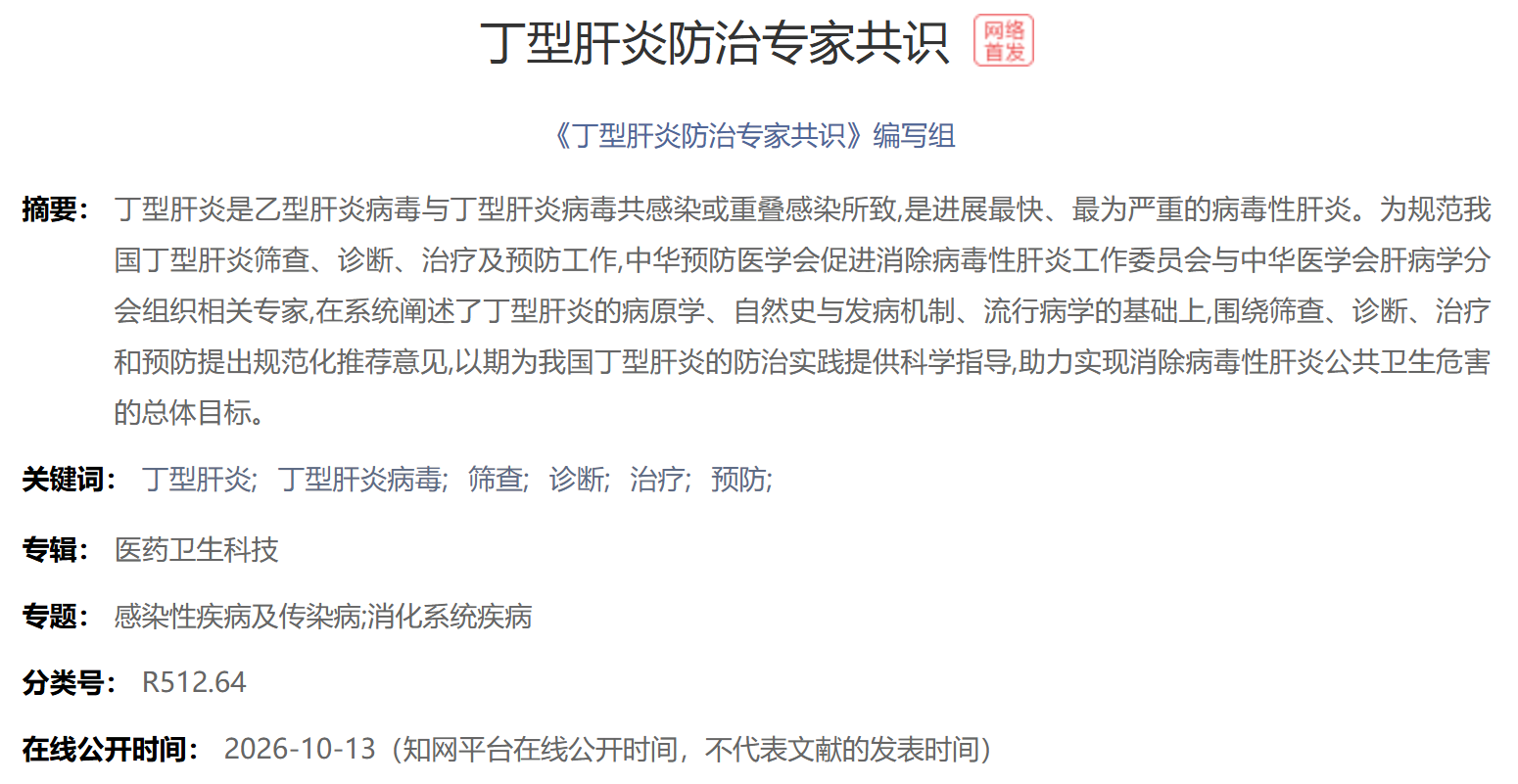
Fifteen Recommendations for Hepatitis D Care
The Consensus provides specific recommendations on screening populations, testing algorithms, follow-up and monitoring, and preventive measures.
Consensus 1:
All HBsAg-positive individuals should receive at least one anti-HDV serological screening test. In settings where laboratory capacity or other resources are limited and universal anti-HDV testing cannot be implemented, anti-HDV screening should be prioritized in the following specific HBsAg-positive populations:
①Patients with chronic hepatitis B who have persistent ALT elevation or disease progression despite standard anti-HBV therapy, after exclusion of other viral infections, including HCV infection, and metabolic liver diseases, including fatty liver disease;
②Patients with acute decompensation of chronic liver disease;
③Patients with advanced liver disease and clinical features suggestive of HDV infection (e.g., low HBV DNA levels with elevated ALT);
④Individuals with a history of residence or travel in regions with high HDV prevalence; or those with documented HDV infection in household members or sexual partners;
⑤Individuals with ongoing high risk of HDV exposure, including hemodialysis patients, individuals with HCV or HIV co-infection, people who inject drugs, men who have sex with men, and sex workers, should undergo annual repeat anti-HDV screening.
Consensus 2:
After the HBsAg test result is positive, anti-HDV (total antibody or anti-HDV IgG) testing should be automatically triggered; if anti-HDV is positive, HDV RNA testing is then reflexively performed. Direct HDV RNA testing following a positive HBsAg result may be considered.
Consensus 3:
HDV RNA is the gold standard for confirming active HDV infection. All individuals with anti-HDV positivity should undergo nucleic acid testing for HDV RNA to determine whether active HDV infection is present.
Consensus 4:
HDV screening should be incorporated into existing national or regional hepatitis B screening programs. A multiplex pathogen testing strategy is recommended to improve screening coverage and efficiency.
Consensus 5:
In patients with acute hepatitis D, anti-HBc IgM testing should be performed to distinguish acute HBV/HDV coinfection from HDV superinfection in HBsAg-positive individuals.
Consensus 6:
Chronic hepatitis D patients with elevated aminotransferase (ALT/AST) and gamma-glutamyl transferase (GGT) levels, advanced liver disease, persistent HDV viremia, high serum HBV DNA levels, coinfection with other viruses, or comorbidities including alcohol abuse, obesity, and diabetes should receive intensified follow-up and monitoring.
Consensus 7:
Patients with a confirmed diagnosis of hepatitis D who test positive for serum/plasma HDV RNA should receive antiviral therapy.
Consensus 8:
Given that chronic HBV coinfects with HDV accelerates liver disease progression, Nucleos(t)ide analogues (NAs) are recommended for the management of HBV infection in HDV-infected patients, in accordance with current guidelines for the prevention and treatment of chronic hepatitis B.
Consensus 9:
For patients with confirmed chronic HDV infection and compensated liver disease, libevitug is recommended as the preferred therapy at a dose of 10 mg/kg (weight) administered intravenously every two weeks. Treatment duration should be individualized according to HDV RNA and ALT responses. A 48-week course is generally recommended.
Consensus 10:
For patients with confirmed chronic HDV infection and compensated liver disease who are unsuitable for libevitug therapy and have no contraindications or intolerance to interferon, PEG-IFNα may be considered as an alternative. The treatment duration should be individualized based on dynamic changes in HDV RNA and ALT levels, as well as treatment tolerability. A 48-week course at a dose of 180 μg once weekly by subcutaneous injection is generally recommended.
Consensus 11:
Patients with chronic HDV infection should undergo routine liver disease assessment every 3 to 6 months. Virologic testing should include quantitative HBsAg, HBV DNA, and HDV RNA.
Consensus 12:
During treatment, quantitative HDV RNA testing is recommended every 3 months to assess virologic response. ALT should be measured at least every 3 to 6 months to determine whether HDV suppression is accompanied by ALT improvement.
Consensus 13:
During treatment, HBV DNA testing is recommended every 6 months for patients with chronic HDV infection who have undetectable HBV DNA and are not receiving nucleos(t)ide analogue therapy. Liver function should be assessed every 3 to 6 months. For patients with cirrhosis or significantly abnormal ALT, more frequent testing may be considered as clinically indicated.
Consensus 14:
After treatment completion, individualized plans for periodic retesting of HDV RNA and HBV DNA should be developed according to the treatment regimen, to monitor possible HBV/HDV reactivation or relapses. If indications for antiviral therapy are met, treatment should be initiated promptly.
Consensus 15:
For newborns of mothers co-infected with HBV and HDV, combined administration of hepatitis B vaccine and hepatitis B immunoglobulin is recommended to prevent mother-to-child transmission. Hepatitis B vaccination is also recommended for other high-risk populations with susceptibility to HDV infection.
Libevitug Recommended as a Preferred Treatment
Under Recommendation 9, Libevitug is a preferred treatment for patients with confirmed chronic HDV infection and compensated liver disease. Treatment duration should be tailored to changes in HDV RNA and ALT levels.
Libevitug (HH-003) is a fully human monoclonal antibody approved in China in 2026. It is the first drug globally to target the PreS1 region of the large HBV surface antigen. By specifically binding to the PreS1 region of the HBV/HDV envelope, libevitug blocks the interaction between virus and the NTCP receptor, thereby inhibiting viral entry into hepatocytes and neutralizing infection. The recommended clinical dose is 10 mg/kg administered intravenously every two weeks. The dose may be increased to 20 mg/kg based on individual patient assessment and evaluation by an experienced physician. The optimal treatment duration remains to be determined. However, a 48-week course of treatment is generally recommended based on the Phase 2b study. In an international, multicenter, randomized, controlled, open-label pivotal Phase 2b study (HH003-204; NCT05861674), 100 patients with chronic HDV infection were enrolled and randomly assigned in a 2:2:1 ratio to receive libevitug 10 mg/kg, libevitug 20 mg/kg, or control, with all groups receiving TAF as background therapy for HBV infection. At week 24, HDV RNA virologic response rates in the libevitug 10 mg/kg and 20 mg/kg groups were 35.5% and 42.5%, respectively, and composite virologic and biochemical (ALT normalization) response rates were 32.4% and 35.0%, respectively. At week 48, HDV RNA virologic response rates increased to 50.0% and 60.0%, respectively, with composite response rates reaching 44.1% and 42.5%, and ALT normalization rates up to 70%. In addition, patients treated with libevitug showed significant improvement in liver stiffness. Libevitug has received Breakthrough Therapy Designation from the National Medical Products Administration (NMPA) of China and the U.S. Food and Drug Administration (FDA) for the treatment of chronic HDV infection.
Over 11 years, Huahui Health has translated original discoveries in viral infection mechanisms into Libevitug through its own drug discovery and development program. Libevitug has received Breakthrough Therapy Designation from both the U.S. FDA and the Center for Drug Evaluation (CDE) of China’s NMPA. As China’s only approved treatment for hepatitis D, it fills a longstanding gap in care. Its efficacy and safety, documented in international multicenter clinical trials, have gained broad recognition within the global hepatology community.
Huahui Health will continue to put patients’ needs first and work with partners to raise awareness of hepatitis D. These efforts aim to promote earlier diagnosis and treatment and help patients benefit sooner. The company is also advancing multiple proprietary drug candidates with first-in-class potential and expanding its viral hepatitis portfolio to address unmet needs worldwide. Huahui Health remains committed to supporting the global goal of eliminating viral hepatitis as a public health threat by 2030.
References
[1] Writing Group for the Expert Consensus on Prevention and Treatment of Hepatitis D. Expert consensus on prevention and treatment of hepatitis D in China. China Preventive Medicine. 2026;27(10):1–14. [In Chinese.]
[2] Chinese Journal of Hepatology WeChat official account. Expert consensus on prevention and treatment of hepatitis D in China. October 15, 2026. Read the original Consensus in Chinese.
About Libevitug (HH-003)
Libevitug is a first-in-class, PreS1-targeting neutralizing monoclonal antibody against HBV/HDV, discovered and developed by Huahui Health. The antibody functions by specifically blocking the interaction between the viral PreS1 domain and the host NTCP receptor, preventing viral entry into hepatocytes and reinfection. The early-stage development of Libevitug received support from the National Major Science and Technology Project for Significant New Drugs Development under China’s 13th Five-Year Plan. On January 20, 2026, Libevitug received conditional approval from China’s National Medical Products Administration (NMPA) for the treatment of chronic HDV infection in adults with or without compensated cirrhosis. Previously, it was granted Breakthrough Therapy Designation (BTD) for Hepatitis D by both China’s CDE, NMPA (2023) and the U.S. FDA (2024).
About Huahui Health
Founded in Beijing in 2015, Huahui Health is a patient-centric biopharmaceutical company with profound scientific expertise, developing innovative therapies to address unmet clinical needs worldwide across viral hepatitis, liver diseases, and oncology. Guided by the core principles of Innovation, Integrity, Collaboration, and Mutual Benefit, Huahui Health has established an integrated R&D system spanning the entire drug development process, with a focus on first-in-class and best-in-class breakthrough therapies.


Tel:010-80766688 Email: info@hhhbio.com
Floor 7-8, Building 5, No.9 Yike Road, Life Science Park, Changping District, Beijing, China
If reporting adverse events, please call the pharmacovigilance hotline at 400 086 0521 (business days: 9:00-18:00), or send an email to: ppv@hhhbio.com. Thank you

Welcome to the Huahui Health, Ltd. website. Please read carefully the following information before visiting this website. By visiting this website, you have agreed to comply with the relevant terms of use.
I. Interpretation
In this website, unless the context requires otherwise, the following expression shall have the following meaning.
“This website”: the website of Huahui Health, Ltd. in both Chinese and English.
II. Intellectual Property Rights
Unless otherwise expressly noted, the copyrights of all information and pictures contained within this website belongs to Huahui Health, Ltd., including, but not limited to written reports, pictures, audios, videos, tables, marks, logos, advertisements, trademarks, domain names, software, programs, layout designs, column catalogues, product names, content classification standards, etc. This website enjoys exclusive rights, and is protected by both Chinese and international copyright laws.
No person or entity may edit, copy, plagiarize, or trade any resource on this website for any commercial purpose. Any violator will be held for corresponding legal liabilities.
III. Protection of Rights
If you are a copyright owner of a work published on this website, and/or the owner who can independently exercise the right to disseminate information on the internet according to the law, and believed your legal right was regarded as being infringed, please notify Huahui Health, Ltd. in written form. You are responsible for the authenticity of the written notification.
IV. Links
This website may link or refer to any third party website (the Third Party Websites). No content of the Third Party Websites is under the supervision or control of Huahui Health, Ltd., and Huahui Health, Ltd. does not recognize or guarantee the authenticity, accuracy, integrity, or safety of such websites. Huahui Health, Ltd. will not be liable for any (indirect or direct) harm or loss arising from your use of, or reliance on, any content, product, service, or the other materials obtained from the Third Party Websites.
V. Information Release and Disclaimer
1. All articles, advertisements, and views expressed by visitors on this website, as well as other content available by links, are general information only for the purpose of reference and learning exchange. Nothing on this website shall be interpreted as endorsement of any product or providing any advice. This website cannot, and does not guarantee the authenticity of the content provided by any website users or that on any links. There is no express or implied guarantees given by Huahui Health, Ltd. as to the authenticity or validity of the contents, products, and services thereof. This website and any affiliate of Huahui Health, Ltd. will not be liable for any activity that the visitor makes based on the information obtained from this website.
2. Except for the terms of use specified on this website, this website will not be liable for any damages resulting from your access to, or use of this website, including but not limited to any accident, negligence, libel, or infringement of copyright and intellectual property rights.
VI. Other
Any behavior of visitors related to this website (including but not limited to browsing, utilizing, reprinting, and publicizing the information from the website) should be prudent and in good faith; visitors should not intentionally damage or cause any damage through negligence any legitimate rights and interests of this website. You may not use this website to violate (directly or indirectly) any laws of People's Republic of China, international conventions, or social ethics.
VII. Applicable law
In the event of any legal dispute arising from the operation of this website, Beijing Changping District People's Court shall be the jurisdictional court.
Huahui Health, Ltd. reserves all rights to explain, modify, and update the relevant terms of use of this website at any time.
Huahui Health, Ltd. (hereinafter referred to as "our company," "we," or "Huahui") highly values your privacy protection. To clearly explain privacy-related matters on our official website, we have revised this Privacy Statement. This statement applies only to our official website (hereinafter referred to as "this website") and aims to inform you of our website's privacy protection principles and information processing practices, ensuring that you fully understand your rights while browsing this website.
I. Company Basic Information
Company Name: Huahui Health, Ltd.
Scope of Application: This statement applies only to the official website of Huahui Health, Ltd. and does not cover third-party websites, applications, or other products/services of our company (if you use other products/services of our company, please refer to the corresponding product/service's privacy statement for relevant privacy matters).
II. Core Principles of Privacy Protection
Legality and Compliance Principle: Our company always adheres to the requirements of relevant laws and regulations, such as the "Personal Information Protection Law of the People's Republic of China," to regulate the operation of this website and privacy protection work, ensuring that all privacy-related actions comply with legal provisions.
Transparency and Openness Principle: This privacy statement clearly and accurately informs you of the information processing practices of this website, without any concealment or misleading content. You can review it at any time to understand the relevant details.
Security Guarantee Principle: Although this website does not have any personal information collection functions, our company will still take necessary technical and management measures to ensure the stable operation of this website system, prevent network security risks, and provide you with a safe browsing environment.
III. Information Processing Description of This Website
This website is a static display website, used only to present our company's basic information (such as company introduction, business areas, product information, contact information, etc.). It does not have any functions for collecting, storing, or processing personal information. Specific details are as follows:
No Personal Information Required: While browsing this website, you do not need to register an account, fill out forms, submit feedback, or perform any operations that require providing personal information (such as name, phone number, email address, etc.) to fully access all publicly displayed information on this website.
No Automatic Collection: This website does not automatically collect your personal information (such as IP address, browsing history, device information, etc.) through any technical means such as cookies, web code, or server logs. The official website server only records necessary, non-personally identifiable access logs (such as access time and accessed pages). This log information cannot identify specific individuals, nor can it be associated with any individual. These logs are used solely for website technical maintenance and troubleshooting, and will not be used for any other purpose or shared with any third party.
No information storage or processing: Because this official website does not collect any personal information, there are no related operations such as "personal information storage," "personal information sharing," or "personal information retention period," and therefore no authorization or consent from you is required.
IV. Your Rights
Right to Information: You have the right to understand the privacy protection principles, information processing practices, and your related rights through this privacy statement.
Right to Inquiry and Feedback: If you have any questions or suggestions regarding this website's privacy statement or privacy protection work, you can contact us through the phone number, email address, or other methods provided in the "Contact Us" section of this website. We will answer or address your questions within a reasonable timeframe.
V. Explanation Regarding Third-Party Links
This official website may contain links to third-party websites (such as the official websites of partner organizations, industry information platforms, academic journal websites, etc.). It is important to note that these third-party websites are not operated by our company, and their privacy protection rules are unrelated to this statement. If you access a third-party website through a link on this website, we recommend that you carefully read the privacy statement of that third-party website before accessing it to understand its information collection and usage rules. Our company is not responsible for the privacy practices or content of third-party websites.
In this Cookie Policy ‘we’, ‘us’ and ‘our’ refers to Huahui Health, Ltd. For more information about the Huahui Health, Ltd. network generally, see .
"Cookies" are small text files created and stored on your hard drive by your internet browser software, in order to hold relevant information about the website you are currently viewing.
We use cookies to monitor your use of the website, to observe behaviour, compile aggregate data and provide users with an improved and more effective service.
Persistent cookies – these will allow our site to recognise you when you return to our site another time. This provides us with useful analytics that help us to optimise our website and your visits.
Session cookies – these exist just for the life of your current visit whilst you have your browser open. They are not stored on your hard disk and are erased when you exit your web browser.
There are a number of ways you can manually manage cookies on your computer/device. If you access the Internet from more than one computer/device it is important to ensure each browser is configured to suit your cookie preferences. If you wish to block all cookies all the time you can set your browser to do this.
Please note that blocking cookies may result in some parts of our site not working as efficiently as they might otherwise do or at all. This may affect your browsing experience.


